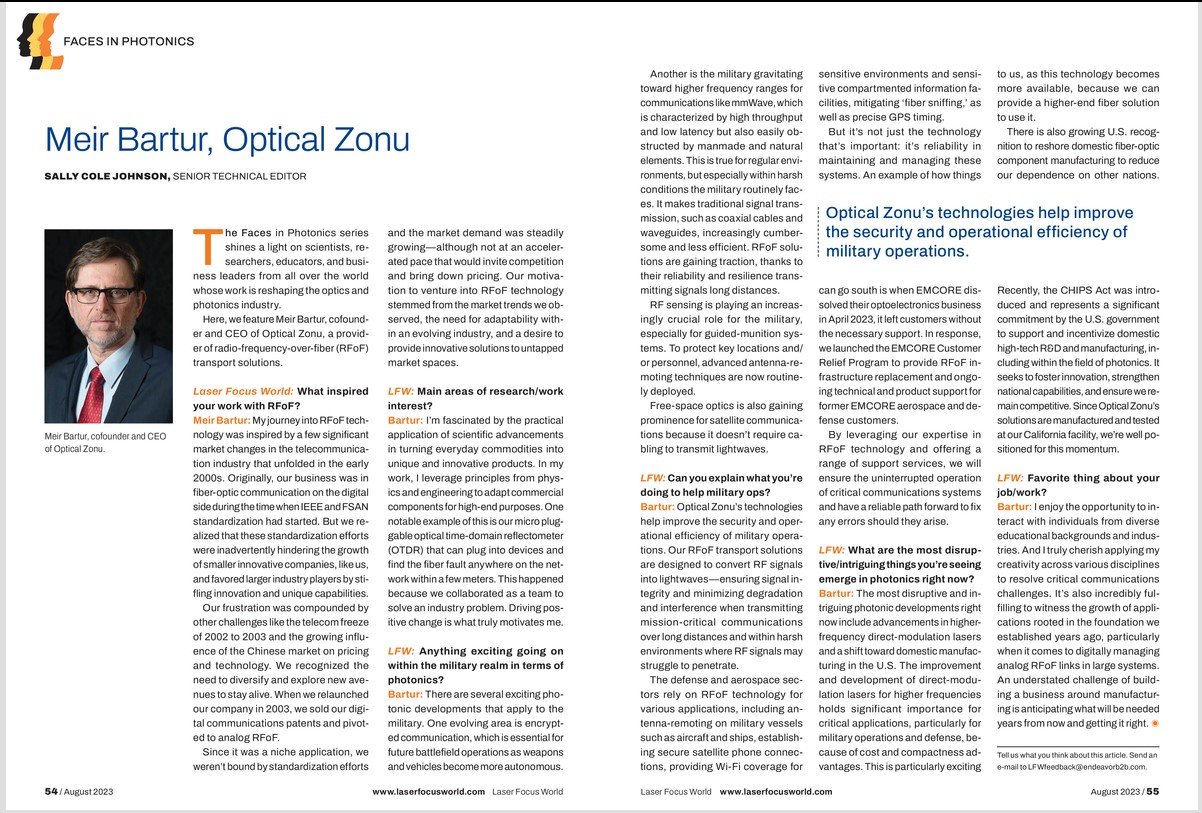
Laser Focus World “Faces in Photonics” interview with Optical Zonu Co-Founder and CEO, Meir Bartur
The Faces in Photonics series shines a light on scientists, researchers, educators, and business leaders from all over the world whose work is reshaping the optics and photonics industry.
Here, we feature Meir Bartur, cofounder and CEO of Optical Zonu, a provider of radio-frequency-over-fiber (RFoF) transport solutions.
Laser Focus World: What inspired your work with RFoF?
Meir Bartur: My journey into RFoF technology was inspired by a few significant market changes in the telecommunication industry that unfolded in the early 2000s. Originally, our business was in fiber-optic communication on the digital side during the time when IEEE and FSAN standardization had started. But we realized that these standardization efforts were inadvertently hindering the growth of smaller innovative companies, like us, and favored larger industry players by stifling innovation and unique capabilities.
Our frustration was compounded by other challenges like the telecom freeze of 2002 to 2003 and the growing influence of the Chinese market on pricing and technology. We recognized the need to diversify and explore new avenues to stay alive. When we relaunched our company in 2003, we sold our digital communications patents and pivoted to analog RFoF.
Since it was a niche application, we weren’t bound by standardization efforts and the market demand was steadily growing—although not at an accelerated pace that would invite competition and bring down pricing. Our motivation to venture into RFoF technology stemmed from the market trends we observed, the need for adaptability within an evolving industry, and a desire to provide innovative solutions to untapped market spaces.
LFW: Main areas of research/work interest?
Bartur: I’m fascinated by the practical application of scientific advancements in turning everyday commodities into unique and innovative products. In my work, I leverage principles from physics and engineering to adapt commercial components for high-end purposes. One notable example of this is our micro pluggable optical time-domain reflectometer (OTDR) that can plug into devices and find the fiber fault anywhere on the network within a few meters. This happened because we collaborated as a team to solve an industry problem. Driving positive change is what truly motivates me.
LFW: Anything exciting going on within the military realm in terms of photonics?
Bartur: There are several exciting photonic developments that apply to the military. One evolving area is encrypted communication, which is essential for future battlefield operations as weapons and vehicles become more autonomous.
Another is the military gravitating toward higher frequency ranges for communications like mmWave, which is characterized by high throughput and low latency but also easily obstructed by manmade and natural elements. This is true for regular environments, but especially within harsh conditions the military routinely faces. It makes traditional signal transmission, such as coaxial cables and waveguides, increasingly cumbersome and less efficient. RFoF solutions are gaining traction, thanks to their reliability and resilience transmitting signals long distances.
RF sensing is playing an increasingly crucial role for the military, especially for guided-munition systems. To protect key locations and/or personnel, advanced antenna-remoting techniques are now routinely deployed.
Free-space optics is also gaining prominence for satellite communications because it doesn’t require cabling to transmit lightwaves.
LFW: Can you explain what you’re doing to help military ops?
Bartur: Optical Zonu’s technologies help improve the security and operational efficiency of military operations. Our RFoF transport solutions are designed to convert RF signals into lightwaves—ensuring signal integrity and minimizing degradation and interference when transmitting mission-critical communications over long distances and within harsh environments where RF signals may struggle to penetrate.
The defense and aerospace sectors rely on RFoF technology for various applications, including antenna-remoting on military vessels such as aircraft and ships, establishing secure satellite phone connections, providing Wi-Fi coverage for sensitive environments and sensitive compartmented information facilities, mitigating ‘fiber sniffing,’ as well as precise GPS timing.
But it’s not just the technology that’s important: it’s reliability in maintaining and managing these systems. An example of how things can go south is when EMCORE dissolved their optoelectronics business in April 2023, it left customers without the necessary support. In response, we launched the EMCORE Customer Relief Program to provide RFoF infrastructure replacement and ongoing technical and product support for former EMCORE aerospace and defense customers.
By leveraging our expertise in RFoF technology and offering a range of support services, we will ensure the uninterrupted operation of critical communications systems and have a reliable path forward to fix any errors should they arise.
LFW: What are the most disruptive/intriguing things you’re seeing emerge in photonics right now?
Bartur: The most disruptive and intriguing photonic developments right now include advancements in higher-frequency direct-modulation lasers and a shift toward domestic manufacturing in the U.S. The improvement and development of direct-modulation lasers for higher frequencies holds significant importance for critical applications, particularly for military operations and defense, because of cost and compactness advantages. This is particularly exciting to us, as this technology becomes more available, because we can provide a higher-end fiber solution to use it.
There is also growing U.S. recognition to reshore domestic fiber-optic component manufacturing to reduce our dependence on other nations. Recently, the CHIPS Act was introduced and represents a significant commitment by the U.S. government to support and incentivize domestic high-tech R&D and manufacturing, including within the field of photonics. It seeks to foster innovation, strengthen national capabilities, and ensure we remain competitive. Since Optical Zonu’s solutions are manufactured and tested at our California facility, we’re well positioned for this momentum.
LFW: Favorite thing about your job/work?
Bartur: I enjoy the opportunity to interact with individuals from diverse educational backgrounds and industries. And I truly cherish applying my creativity across various disciplines to resolve critical communications challenges. It’s also incredibly fulfilling to witness the growth of applications rooted in the foundation we established years ago, particularly when it comes to digitally managing analog RFoF links in large systems. An understated challenge of building a business around manufacturing is anticipating what will be needed years from now and getting it right.